
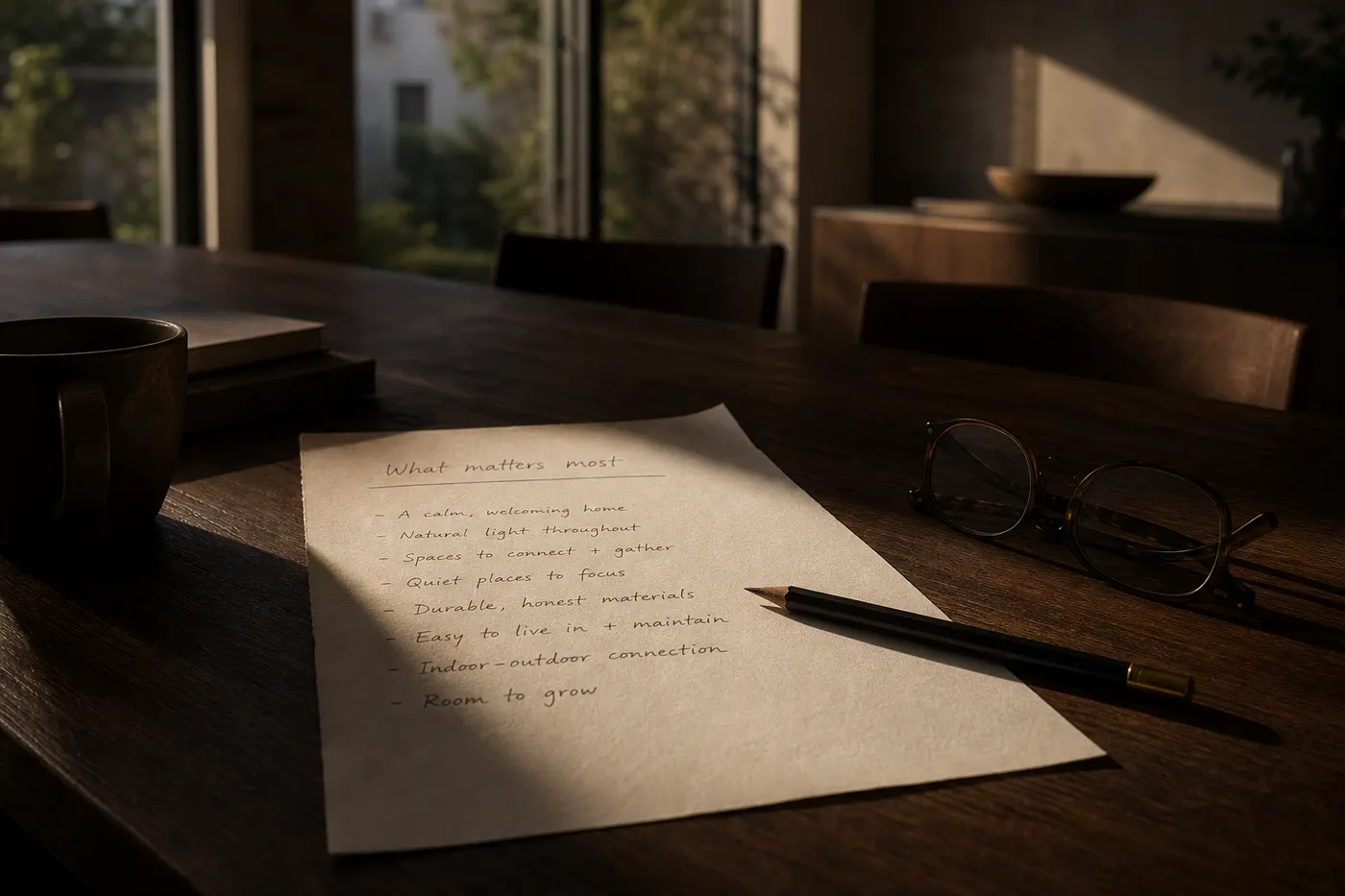
A good brief is not a style document. It is a protection document: it tells the designer what must not be lost — the morning light in the east room, the budget's true ceiling, the storage a family of five actually generates, the grandmother's cupboard that stays. Style references help, but they are vocabulary, not instructions. The brief that produces a good home answers four questions before the first meeting: how do we actually live, what is the honest budget, what are the non-negotiables, and who decides. Everything else is legitimately the designer's job to propose.
The problem
Most briefs arrive as a folder of saved images and a square-foot number. Both are useful and neither is a brief. The images describe other people's homes — usually other climates, other budgets, other lives — and the number describes an area, not a life lived inside it.
What's missing is the information only the family possesses: that dinner happens in front of the television, whatever the dining table pretends; that one member works nights and sleeps mornings; that the household runs on a domestic help's workflow the kitchen must serve; that the balcony is where tea and the day's first conversation happen. A designer can propose around anything that's stated. What sinks projects is what surfaces in month three — the priority nobody wrote down, discovered after the drawings that ignored it are approved.
The second gap is budget theatre: a stated number with an unstated real number behind it. Designers design to the stated figure; families then stretch quietly toward the real one item by item, and the project loses the coherence a single honest number would have bought.
What a brief should contain
1. The life audit — how the home actually works. One page, honestly: who lives here, and who will in five years. Where does each person spend their hours? Where do guests actually sit? What does a weekday morning look like — the bottlenecks, the queue for the bathroom, where the ironing happens? What does the household generate that must be stored: how many people's clothes, how much kitchen inventory, luggage, festival things, the file boxes nobody discusses? Storage is where most Indian homes fail quietly, and it fails because the brief counted rooms instead of belongings.
2. The non-negotiables — what the project must protect. Every home has three to six of these, and naming them is the brief's core act: the cross-ventilation that makes summers livable, the reading corner's light, the pooja space's position, the budget discipline itself, a piece of furniture that carries the family in it. Write them down and rank them. When trade-offs arrive — and they always arrive — this list is what decides, instead of whoever spoke last.
3. The honest budget, with its structure. One number, the real one, plus two clarities: what it includes (does it cover soft furnishing, appliances, light fittings, civil surprises?) and where the flexibility lives (a 10 percent contingency named upfront beats ten small overruns negotiated in fatigue). A designer told the truth can propose the best home that number buys. A designer told a hopeful number proposes a home the family then dismantles item by item — the most demoralizing way to spend the same money.
4. References as vocabulary, not contract. Bring the saved images, but annotate them: what in each image speaks — the calm of it, the wood tone, the way the kitchen opens, the wall of books? Three images with reasons outteach thirty without. And state the anti-references too: what the family definitely doesn't want is often the sharpest brief line of all.
5. The practicalities that shape everything. Timeline and its reason (a lease ending is a fact; "as soon as possible" is a mood). Whether the family lives in during work — occupied renovation changes sequencing, dust discipline, and cost. Maintenance appetite, stated honestly: white sofas and high-polish surfaces are commitments, not colours. Any household staff workflows the design must serve. Vastu or other requirements, if they matter, declared at the start — retrofitting them into finished drawings is the expensive version.
6. Who decides. One person signs off, or two who agree to disagree privately and decide jointly. A brief with three approvers is three briefs. Name the decision-maker in the first meeting; every designer will quietly thank you, and the schedule loudly will.
What to leave open — the other half of a good brief
A brief over-specified is a designer reduced to a draughtsman. The family owns the what: priorities, budget, life patterns, non-negotiables. The designer owns the how: layouts, materials, proportions, the moves the family hasn't imagined — which is what they're being engaged for. The best briefs state problems, not solutions: not "we want a partition here," but "the entrance opens straight into the living area and we'd like arrival to feel more gradual." The second version has ten answers, some better than the partition.
Why it matters
The brief is the cheapest document in the entire project and the most leveraged: every drawing, BOQ line, and site decision descends from it. An hour of honesty in the brief saves weeks of revision later — because revision is redesign wearing a politer name, and mid-project redesign is paid for in money, time, and the family's enthusiasm, the project's least renewable resource.
ASAPCON's lens
Our first meetings are structured around exactly these questions — we'd rather spend the opening hour on how a family's Tuesday works than on any image folder. We ask for the non-negotiables ranked, the budget with its structure, and the anti-references alongside the references. And we put the brief in writing after that meeting, sent back for the family's correction: the document both sides then design against, and the document trade-offs are settled against when they come. A brief that lives only in conversation is a brief each side remembers differently by month two.
Practical takeaways
- Write the life audit: who, what hours, what routines, and a real count of what needs storing.
- Name and rank three to six non-negotiables — the list that settles every future trade-off.
- Give the honest budget with its inclusions and a named contingency, not a hopeful number with a shadow behind it.
- Annotate references with why, add anti-references, and state problems rather than prescribing solutions.
- Declare the practicalities — timeline's reason, living-in status, maintenance appetite, vastu — and appoint one decision-maker.
Closing thought
A designer can be brilliant with information and only lucky without it. The brief is where a family stops being a client and becomes a collaborator — and the homes that feel inevitable a year later almost always began as an honest page, written before anyone drew a line.