
A landscape in Kolkata is designed for two opposite failures: roots drowning in July and beds baking in May. The plant list, which gets most of the attention, is actually the third decision. First comes water — where every drop of monsoon rain goes, at what slope, into what drain or ground. Second comes soil and level — beds built to drain, lawns graded to shed. Only then does the palette matter, and the palette that works here is the one that tolerates both standing humidity and hard sun, chosen for its habits, not its nursery photograph.
The problem
Most landscape work begins as decoration: a lawn, a border of whatever the nursery had in flower, a few feature palms, pavers to fill the rest. The first monsoon then runs the real test. Water ponds where the grading never thought about it; lawn roots sit in saturation and rot in patches; beds against the boundary wall become the compound's drainage by accident; and pavers laid flat become a mirror-calm puddle map. By October the garden is being repaired. By the second May, the species that loved the nursery's shade net have surrendered to the west sun.
The quiet cause: landscape was treated as planting, when in this climate it is first a civil work — levels, drainage, soil structure — wearing plants.
The site's lessons
Water first: give every drop a route. Walk the site imagining the heaviest hour of rain. Every paved surface needs a fall — gentle but real — toward a drain, a channel, or a designed percolation area, never toward the building. Lawns need grading that sheds rather than cups. Where the ground itself drains poorly, and Kolkata's clayey soils often do, beds want raising and lawns want a soil profile that lets water leave. A landscape drawing without spot levels is a wish.
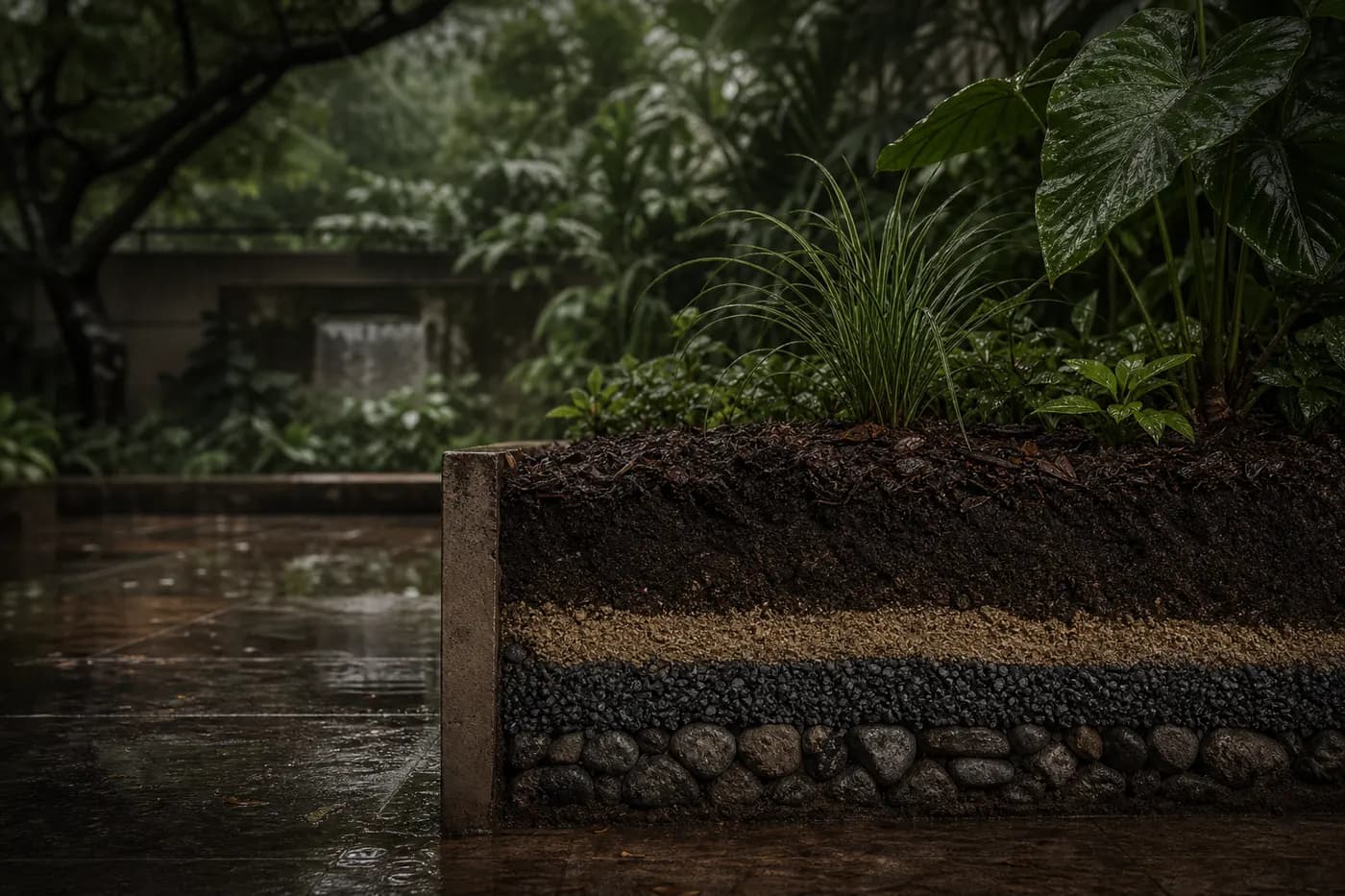
Build the soil before buying the plants. Local clay holds water in monsoon and sets hard in summer — the worst of both seasons. Beds earn their keep when built as a profile: a draining base, amended soil with organic matter and sand opening the structure, and mulch on top buying moisture through May. Raised beds solve half of Kolkata's planting problems before a single sapling arrives.
Choose species by their habits. The reliable performers here are the ones the city itself demonstrates: frangipani and bougainvillea shrugging at the sun, ixora and hibiscus flowering through humidity, palms and ferns each in their right exposure, and native and naturalized trees that pre-date every catalogue. The selection questions that matter: does it tolerate brief waterlogging? Does it take west sun or need shade? What does it drop, and onto what? How big is it in year ten — and what will its roots do to the paving and the compound wall by then? A tree is a 30-year resident; plant it where year ten is welcome.
Hardscape is drainage you can walk on. Paver joints that percolate, channels that are designed rather than improvised, anti-skid surfaces for the five slick months, and edges that hold soil back from washing across paths. The paving pattern photographed on day one matters less than the puddle map on day ninety.
Design the maintenance, not just the garden. Every landscape is a promise of labour. A lawn is the most expensive promise per square foot — mowing, watering, patching — and often the least used surface on the site. Groundcovers, shrub masses and shaded seating frequently serve a housing society or office frontage better than turf that exists to be looked at. Whatever is designed, design its watering (source, points, or drip lines) and its access: a bed nobody can reach becomes a jungle politely, then not.
Why it matters
Landscape is the first thing a visitor reads and the first budget line to be treated as optional — until the waterlogging enters the parking level, the roots enter the paving, or the "low-maintenance" garden reveals its actual invoice. Done as civil work first, a landscape protects the building's edges, cools its surroundings, and improves with age like nothing else on the site. Done as decoration, it is an annual repair subscription.
ASAPCON's lens
We start landscape work where the water starts: a levels-and-drainage plan with spot levels, falls, and every outlet named — approved before any planting plan exists. Soil profiles and bed construction go into the BOQ as built items with depths and mixes, not as "gardening." The planting palette is then selected by exposure map — sun hours per zone, waterlogging risk per zone — with the ten-year size drawn, not imagined. And every proposal ships with its maintenance calendar: what needs doing monthly, seasonally, and what was deliberately chosen so that it needs almost nothing. A client should sign off on the labour, not discover it.
Practical takeaways
- Approve a levels-and-drainage plan before any planting plan; every surface needs a fall and every fall needs a destination.
- Build beds as soil profiles — drainage base, amended mix, mulch. Raised beds beat Kolkata clay.
- Select species for waterlogging tolerance, sun exposure, and year-ten size; plant trees where their decade is welcome.
- Treat paving as drainage: percolating joints, real channels, anti-skid surfaces for the wet months.
- Sign off on the maintenance calendar with the design — a lawn is a subscription; buy it knowingly.
Closing thought
The gardens that look effortless in their fifth year are the ones where the effort happened underground, in the levels and the soil, before anything green arrived. What survives both July and May was never luck.