
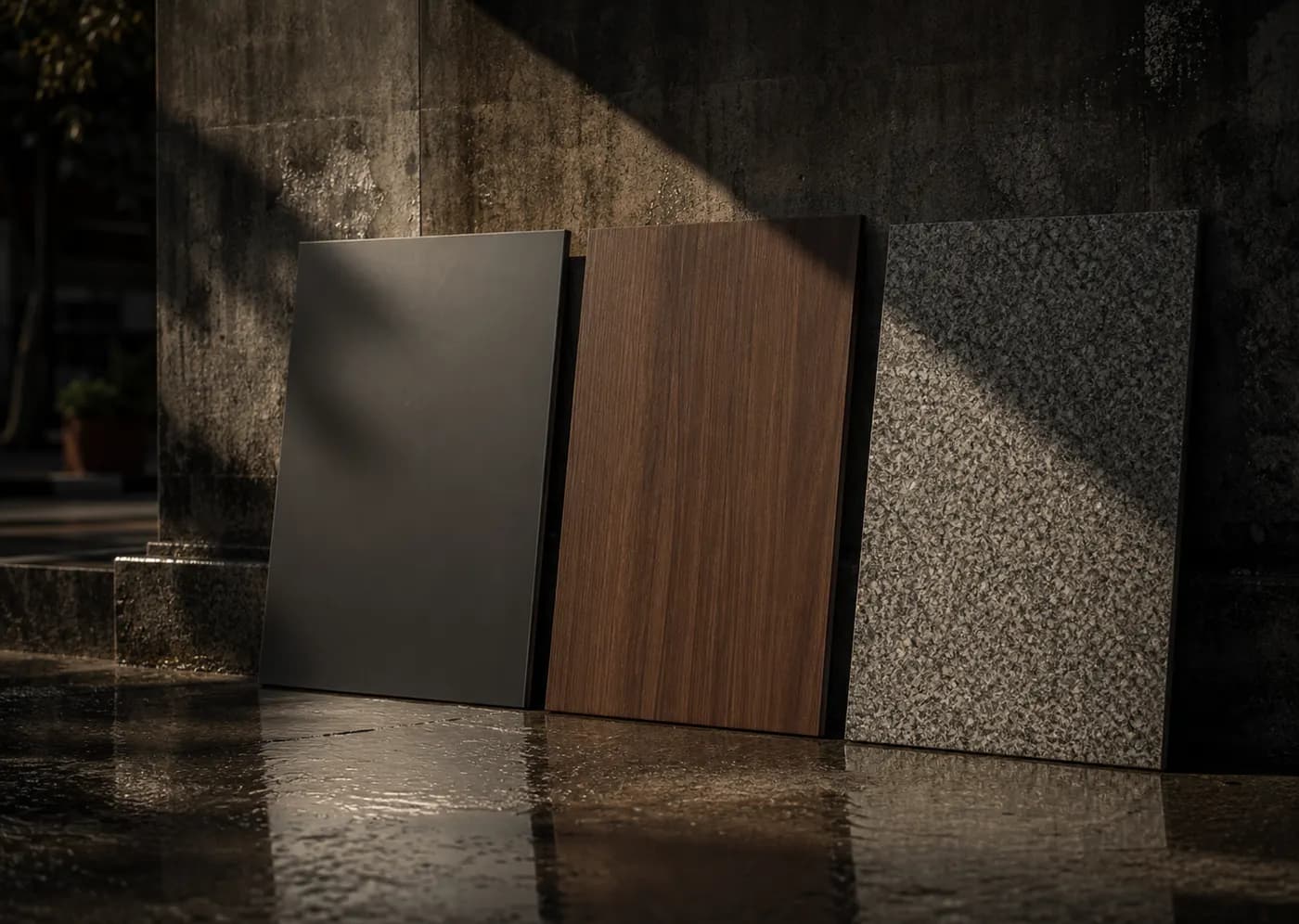
There is no best facade material — there is a best material for a given face of a given building, chosen for how it handles four things Kolkata guarantees: driving monsoon rain, months of high humidity, hard summer sun, and airborne dust that turns every unmanaged water path into a visible streak. ACP offers lightness and crisp flatness but must be specified by its fire grade, not its colour chart. Exterior-grade HPL brings warmth and depth but lives or dies by its fixing system and edge treatment. Stone outlasts both and forgives the least at the detailing stage. The choice is a 20-year decision usually made in a two-week window.
The problem
Facade materials are commonly selected from a render — which face reads best in the 3D view — and specified by brand and shade. What the render cannot show: how the panel meets rain, what the joint does with water, whether the core burns, how the face fades on the western sun, and who will clean it in year six, from where. Facades fail slowly and publicly. A wardrobe that fails embarrasses a bedroom; a facade that fails embarrasses the building's every photograph for a decade.
The decision
ACP (aluminium composite panel). Two aluminium skins over a core — and the core is the specification that matters. Standard polyethylene cores are combustible; fire-retardant (FR) cores exist precisely because facade fires spread through cladding, and the grade belongs in writing on the BOQ, not in a verbal assurance ⟨specify grade with facade consultant per applicable fire norms⟩. Done well — FR core, proper cassette or rout-and-return fixing, sealed or rain-screen joints — ACP delivers flat, light, fast cladding well suited to commercial frontage and large planes. Its weaknesses: dents are forever, a poor joint layout shows every panel line, and cheap coil coatings chalk and fade unevenly on west faces.
Exterior-grade HPL (compact laminate). A dense phenolic board rated for exterior exposure — a different animal from interior laminate, and the datasheet should say so explicitly. It brings wood tones and matte depth that ACP cannot, and takes concealed or exposed mechanical fixing on a ventilated rain-screen frame, which is where it belongs; glued or poorly ventilated installations trap moisture behind the board and cook it. Edges and rear ventilation decide its life. Sun-facing installations need the UV-rated surface grade, or the west facade will announce the shortcut in three summers.
Stone (and its honest substitutes). Granite and quality porcelain slab handle Kolkata's weather with indifference — the failures are almost always fixing and water management, not material. Wet-cladding thin stone on adhesive belongs only at ground-friendly heights; above that, mechanical cladding with designed joints is the adult solution. Stone's real costs are weight (the structure must know early), edge and corner detailing, and the discipline of copings and drips — because stone stains beautifully and permanently when water is left to organize itself.
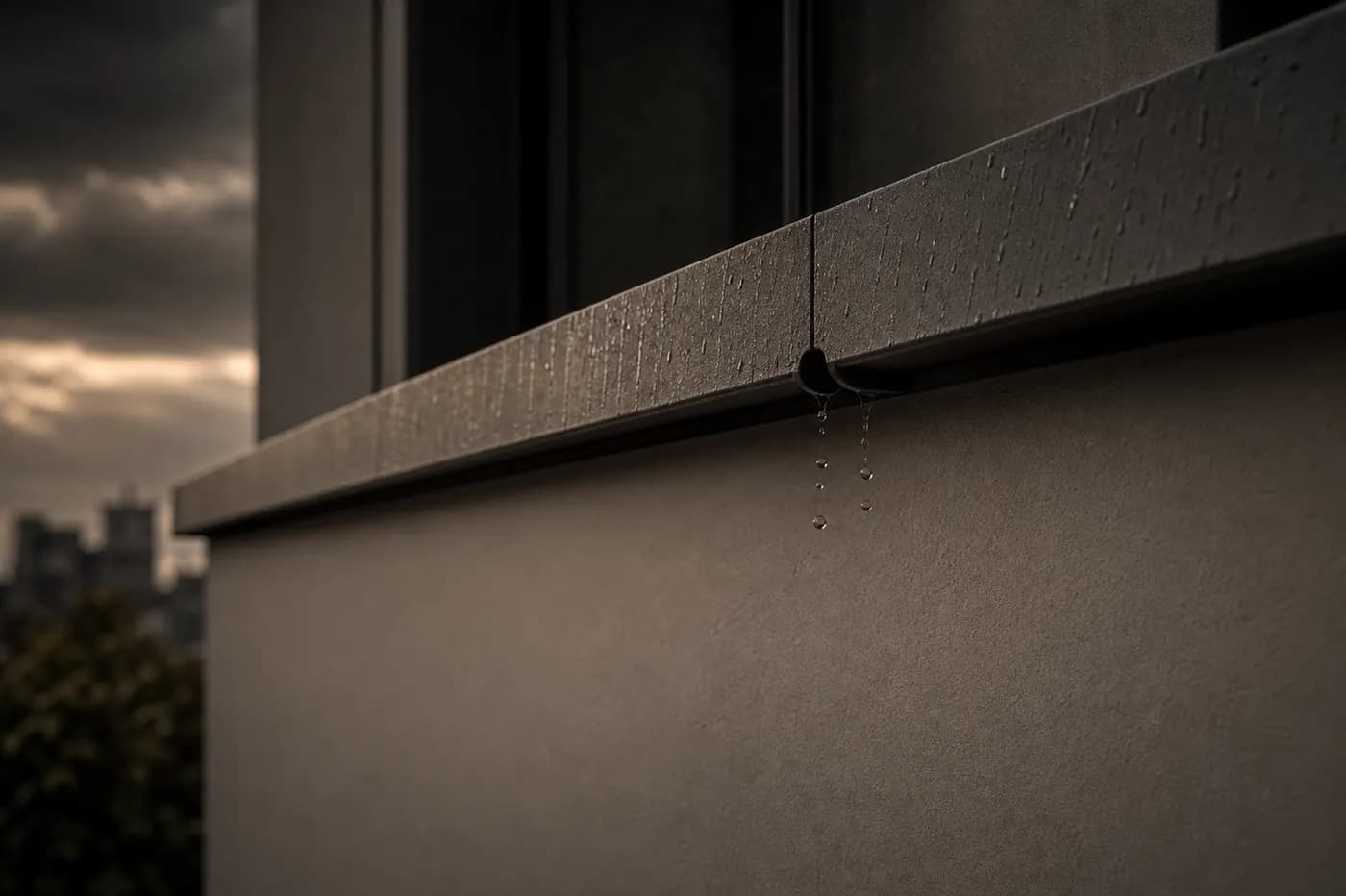
The detail that outranks the material: managing water. Most "material failure" on Kolkata facades is streaking — dust deposited by humidity, then dragged by monsoon runoff along whatever path the detailing forgot. Copings that project and drip, sills that throw water clear, grooves under every horizontal edge: these 20mm decisions keep a face clean for decades and cost almost nothing at design stage. No material survives their absence gracefully.
And the question nobody asks in week one: access. Every facade needs cleaning and, eventually, repair. If the material choice assumes cradle access the building will never own, the facade's maintenance plan is a hope. Choose materials and joint systems the building can actually reach.
Why it matters
A facade is the building's permanent handshake — for a commercial building, it is marketing that either compounds or depreciates. It is also, post the last decade's cladding-fire lessons worldwide, a safety system: core grades and cavity barriers are not paperwork. And it is a running cost: glare, heat gain, cleaning cycles, and panel replacement all trace back to a fortnight of decisions at design stage. The cheapest facade per square foot is very rarely the cheapest facade per decade.
ASAPCON's lens
We select facade materials face by face, not building by building — the west face and the shaded north face are different problems wearing the same elevation. The sequence: water first (copings, drips, joint drainage drawn before any material is named), then fire and fixing (grades and systems written into the BOQ by standard, mock-up panel approved on site before bulk order), then finish. Every horizontal edge in our facade drawings carries a drip; every material carries its access answer. A facade sample signed off at arm's length in a meeting room tells you nothing — we insist on viewing the mock-up at street distance, in afternoon sun, after a wet morning if the season allows. That is the light the building will actually live in.
Practical takeaways
- Specify ACP by core fire grade in writing; the colour chart is the last decision, not the first.
- Exterior HPL only as exterior-grade, mechanically fixed on a ventilated rain screen — its edges and air gap decide its lifespan.
- Stone problems are fixing and water problems: mechanical cladding at height, copings and drips everywhere.
- Draw the water path before choosing the material — streaking is a detailing failure that every material fails under.
- Ask the access question at design stage: what the building cannot reach, it cannot maintain.
Closing thought
A good facade is mostly invisible engineering wearing a thin layer of taste. When the water has somewhere to go, the core is honest, and the fixings expect the decades — the material choice becomes what it should have been all along: the easy part.